Happenings January 2026

January 2026

Home Hydroponics Can Help Chase Away the Winter Blues
by Jennifer Lerner, Senior Resource Educator
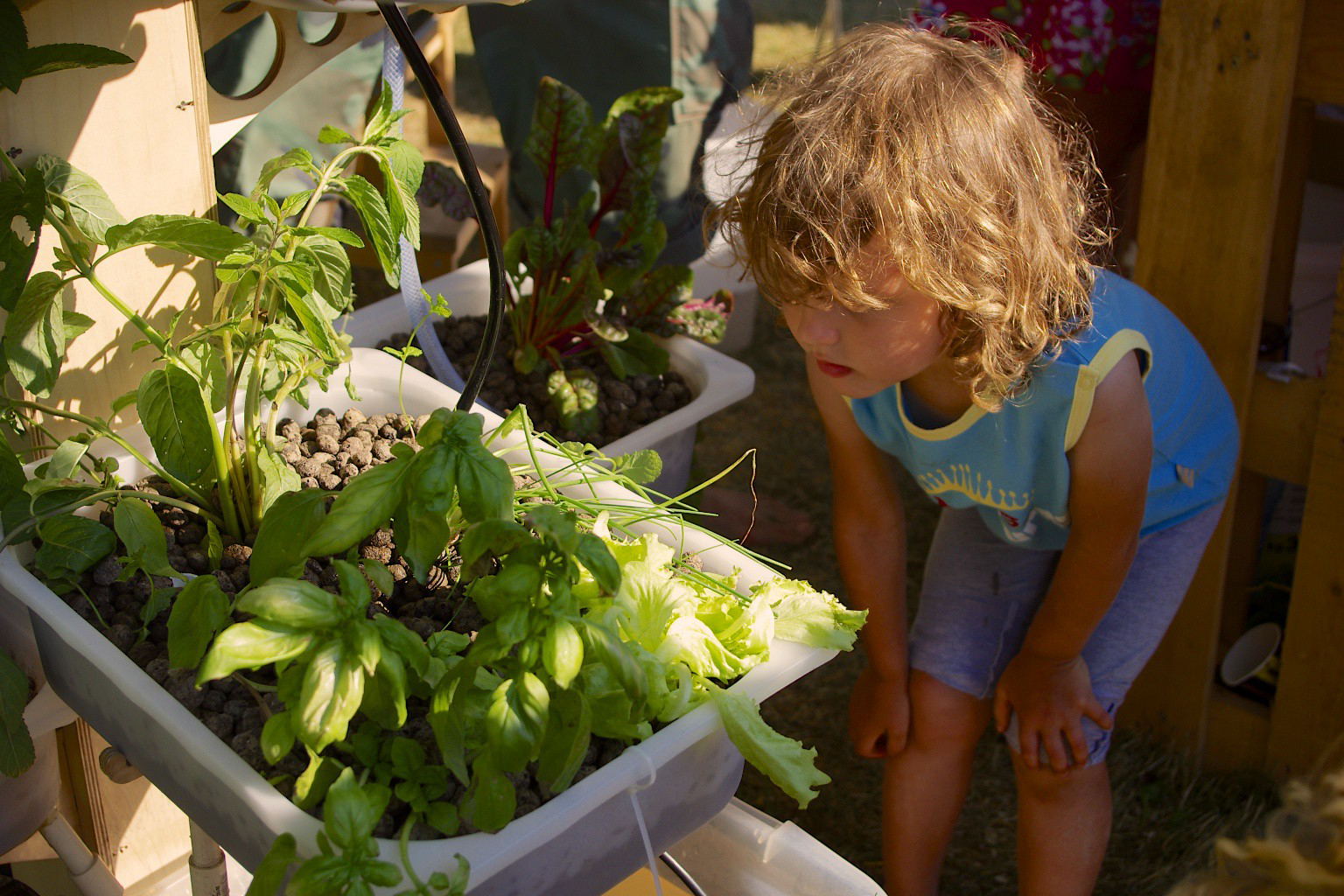
Brighten up your home this winter with hydroponically grown herbs and vegetables. From ready-to-go hydroponic kits to DIY home-grown hydroponic set ups, here are the basics you’ll need for success.
Plants need water, light, air and nutrients to thrive. Hydroponic growing has all the same elements except you are growing plants without soil. Nutrients and air are dissolved in water to keep roots healthy and fed. Keeping in mind that any successful hydroponic set-up requires you deliver water, light, air and nutrients, let’s take a deeper dive into each.
Depending on the type of hydroponic system, water carries nutrients and air to the root system in different ways. Plants either stand in deep water (Deep Water Culture) or a thin film of water washes over their root systems (Nutrient Film Technique). Even within those two basic divisions there are many variations. You’ll find hydroponic kits that use expanded clay beads, buckets, troughs, or trays. A simple search online can show you dozens of cheap, easy ways to make an indoor hydroponic garden with commonly available materials. But the devil’s in the details, so here’s the first important element you won’t want to miss.
If you have ever grown a plant cutting in a glass of water, it is very similar to hydroponics. However, that simple system lacks the benefits of aeration. Roots breath and exchange gasses within their growing substrate, whether it is soil or water. Without enough air exchange, roots are starved for oxygen and build up waste products. In these conditions, they are likely to succumb to bacterial rot. The result can be rather stinky. To avoid this, your hydroponic set up should include aeration of some sort. In the case of nutrient film technique, the flow of water over root surfaces is enough exposure to air. In deep water culture an aerator of some sort is necessary. This is usually a simple, inexpensive fishtank pump.
Our second important element is lighting. Herbs and vegetables growing indoors require supplemental light. Without bright, adjustable-height lights, plants will be leggy and thin, when what you really want is robust and luscious. Hydroponic kits usually include LED lights. If you are building your own system, choose adjustable-height LED lights. There are so many to choose from, and they are relatively inexpensive and easy to find.
Lastly, hydroponic success depends on managing nutrients in solution. If you have ever used water-soluble fertilizer, you’ll be familiar with some aspects of feeding plants. In soil we often focus on Nitrogen (N), Phosphorus (P), and Potassium (K), relying on the soil to deliver many other micronutrients. In hydroponics, you’ll have to deliver all a plant’s nutrition in the water. Hydroponic fertilizers are available and tailored to what you want to grow. Here’s the tricky part: As the plant grows it uses nutrients, some more than others, and you can’t really tell what is left in the water. Growers use electroconductivity probes and frequent water tests to fine tune nutrition. For home growers, observing growth and leaf color can help you determine which nutrients are depleted. A simple search online can give you photo examples of each nutrient deficiency depending on the crop. You can tailor your fertilization based on those observations. In home hydroponics, you may even want to start with a fresh solution to keep things simple.
What can you grow indoors? Fast growing herbs like basil, cilantro and parsley are a great place to start. Lettuce, arugula and other salad greens are easy to grow hydroponically as well. With most of these plants you can harvest individual leaves and let the plant’s roots and stems remain to grow consecutive harvests. Are you ready to dive in?
Here are some specific resources to get you started:
A Guide to Home Hydroponics for Leafy Greens: https://www.purdue.edu/hla/sites/master-gardener/...
Small Scale Hydroponics: https://extension.umn.edu/how/small-scale-hydropo...
Hydroponics at Home: https://extension.unh.edu/resource/hydroponics-ho...
Photo by Maciej Wojnicki (CC BY 2.0)
Bug of the Month: Winter Crane Fly
by Janis Butler, Master Gardener
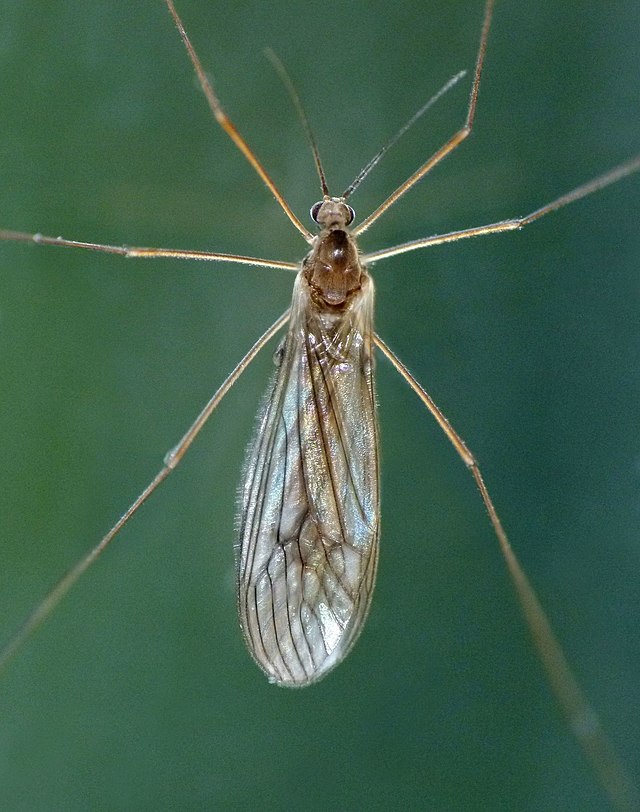
Have you seen many insects this winter? Probably not, since most of them are tucked away in leaf litter or hollow stems, or snuggled underground. Not so for winter crane flies. Though they too depend on leaf litter, hollow trees, and other moist, dark places for winter habitat, they’re famous for bursting forth on mild winter days, swarming against the dazzle of sunlit snow.
Most winter crane flies are in the genus Trichocera, whose member species share an ability to thrive in cold weather and earning their nicknames: winter gnats or winter midges. How do they do it? By supercooling their bodies with proteins that function like antifreeze, allowing them to survive without having their tissues freeze. The adults also make it through the coldest months by clustering together in caves, hollow trees, abandoned buildings and other relatively warm places. When the temperature rises to the 40s (F), they seemingly come to life though they are often seen even when the temperature is as low as the upper 20s (F).
The harmless swarming flies are mostly males looking for a mate among the females who are simultaneously active and equally harmless. After finding each other, they grapple for a while and eventually drop to the ground to mate. The female lays her eggs on or near a good food supply for the emerging larvae, sometimes excavating under the snow to find it.
Ecosystem roles
The larvae hatch in early spring and begin a season of hearty eating while molting three times before fall. The tiny grubs are mostly saprophagous, meaning that they feed on decaying plant matter. As decomposers, they are valuable contributors to the food web, thriving on rotting leaves and wood, fungi, manure, carrion, and even sewage, near the spot their mother selected for them. Rodent burrows are a top choice: warmth from the rodent and food from the excrement.
Pupation takes place in fall. The timing varies widely but the appearance of adults probably peaks between October and February, which is when we get to enjoy seeing them.
Cool weather is key to their life cycle. Being active in winter is a good survival strategy because there are fewer predators around in the coldest months. In warmer months, however, and as further evidence of their ecological importance, there are plenty of critters who welcome a winter crane fly snack, either as larvae or adults. Mammals (skunks, raccoons), birds (starlings, robins, juncos, phoebes, crows and many others), frogs, toads, bats, ground and rove beetles, spiders, ants, fungi, and even some nematodes will gladly feast on them, making winter crane flies a major part of the food chain.
Not mosquitoes!
If adult winter crane flies could talk, they would beg us not to confuse them with mosquitoes, who share a similar body shape: long, skinny legs and bodies and delicate wings. And like most mosquitoes, the adults are small, only about 1/4 to 1/2 inch long. Their beautiful semitransparent wings lie flat on their backs and extend way beyond their abdomens.
The 28 recognized species of Trichocera in North America are hard to differentiate without a hand lens but all winter crane fly species have five eyes: two compound eyes with multiple lenses and three ocelli, or simple eyes, located atop their heads. The ocelli, which true crane flies lack, act as light sensors to aid in navigation and stability. Like all members of the Diptera order, winter crane flies have two wings plus a pair of halteres or vestigial wings located behind the true wings. Halteres function like gyroscopes to aid in balance and orientation during flight. Winter crane flies are smaller than true crane flies and are further distinguished from these near-relatives by their ability to fly in freezing conditions, which true crane flies cannot do.
How can we help winter crane flies?
Don’t mistake winter crane flies for true crane flies. While most are beneficial, some true crane fly species are invasive and have become a problem in lawns, where the grubs feed on grass roots, crowns and shoots, causing brown patches in lawns.
Leave leaves alone in fall to provide winter habitat.
Don’t disturb rotting logs and other woody debris if you can avoid doing so because it could be habitat for many recyclers like winter crane flies.
Photo by Steve Kerr via Wikimedia Commons (CC BY 4.0)
Common Persimmon: A Native Gem Worth Savoring
from Purdue Extension
.jpg?1767118979)
If you’ve ever stumbled upon a tree heavy with orange fruit late in the fall—sometimes after the leaves have dropped—you might have discovered one of North America’s sweetest surprises: the common persimmon (Diospyros virginiana). Also known as “the fruit of the gods,” this native tree is as beautiful as it is bountiful and has been part of our region’s natural and cultural landscape for centuries.
Persimmons add real character to the landscape. Their glossy, oval leaves turn a rich golden hue in autumn, and their fruit—small, round, and sunset-colored—dangles like ornaments well into winter. Birds, deer, foxes, and other wildlife adore them. And yes, humans do too—once ripe! (Taste one before it’s soft, and you’ll understand why early settlers learned patience fast.)
Native to eastern and central North America, the persimmon thrives in a variety of soils and is remarkably resilient—just the kind of hardy native tree gardeners appreciate. Its deep taproot makes it drought-tolerant and helps prevent soil erosion, while its fragrant flowers provide nectar for pollinators. It’s dioecious, meaning separate male and female trees, so you’ll need at least one of each nearby to enjoy fruit production.
Historically, Native Americans and early settlers valued persimmon fruit for drying, baking, or fermenting into a flavorful drink. The wood—dense and fine-grained—was used for everything from golf club heads to furniture. Today, the tree is cherished both as a wildlife magnet and for its ornamental beauty.
So, if you’re looking to plant something native, resilient, and nostalgic, make room in your yard for a persimmon. Better yet—mark your calendar for our annual Tree and Seedling Sale at Tilly Foster Farm, April 17–18, 2026, where you can bring home your very own Diospyros virginiana. Let’s celebrate the season by planting a piece of native history!
Adapted from: The Fruit Of The Gods From An Indiana Tree? | Purdue Extension Forestry & Natural Resources
Resource: Diospyros virginiana (Eastern persimmon) | Native Plants of North America, https://www.wildflower.org/plants/result.php?id_p...
Photo by vastateparksstaff via Flickr (CC BY 2.0)
CPSC Offers Tips to Prevent Injuries While Enjoying Outdoor Activities
from U.S. Consumer Product Safety Commission

Along with bone chilling temperatures, the winter season can bring a host of outdoor activities like sledding, skating, and skiing, as well as chores like using a snow blower. In an effort to reduce winter hazard incidents, the U.S. Consumer Product Safety Commission (CPSC) is urging consumers to keep safety in sight while playing or working in cold weather.
According to the latest CPSC data, in 2022, there were an estimated 124,700 winter sports-related injuries treated in emergency rooms nationwide. Of all injuries:
- 53% occurred during snow skiing and snowboarding,
- 17% during ice hockey,
- 16% while ice skating,
- 10% while using toboggans, sleds, and snow discs,
- and 4% while using snowmobiles.
Common injuries from winter sports include sprains, strains, dislocations, and fractures. But even if you are not playing winter games, caution and care must be taken while doing outdoor chores like using a snow blower. Last year there were over 4,700 snow blower-related injuries treated in the ER, with 36 percent of those injuries to the wrist, hand, and/or finger.
Many of these incidents can be avoided by following some practical safety tips while enjoying the winter wonderland.
Winter Sports Safety – Helmets Make a Difference
- Wear appropriate protective gear, including goggles, helmets, gloves, and padding.
- Wear a properly fitted helmet to reduce the risk of a head injury.
- Wear the right helmet for the activity. Check out our helmet safety publication Which Helmet for Which Activity for more information.
- Check that equipment is working properly prior to use.
Snow Blower – Clear Snow Safely
- Do NOT try to clear snow from the discharge chute of a snow blower with your hands – this is when most snow blower injuries happen.
- Read the snow blower’s manual before using it.
- NEVER leave a gas-powered snow blower running in an enclosed area. The exhaust contains poisonous carbon monoxide, which can kill in minutes.
- To avoid fire, do not add gasoline to a running or hot engine; always keep the gasoline in a gas can or portable gasoline container with a child-resistant closure to prevent child poisonings.
Check for Recalls
Check your home before bringing out winter-related products, check if your products were previously recalled.
Report any unsafe products or any incidents where someone was injured by a product to CPSC at SaferProducts.gov.
4-H News: Fun Activities to Try at Home
from Brandy Keenan, 4-H Educator

Winter weather have you stuck indoors with nothing to do? We've got you covered. Here are some fun activities to do on a day when it's just too yucky to play outside.
Melting Ice Race
Place four identical ice cubes in separate bowls. Cover one with salt, one with sugar, one with sand, and leave the last one as a control. Observe which one melts first, second, and so on, to see how different substances affect the melting rate.
Source: Frugal Fun for Boys and Girls
Homemade Ziplock Bag Ice Cream
Get the wiggles out while making this recipe.
Ingredients
- 2 tablespoons granulated sugar
- 1 cup half and half
- ½ teaspoon vanilla extract
- ½ cup salt – the bigger the granules the better, kosher or rock salt works best, but table salt is fine
- Ice cubes (enough to fill a gallon size bag about half full
- 1-pint size Ziploc bag – durable freezer weight is best
- 1-gallon size Ziploc bag – durable freezer weight is best
Directions
1. Combine the sugar, half and half, and vanilla extract in the pint size bag and seal it tightly.
2. Place the salt and ice in the gallon bag then
place the sealed smaller bag inside as well. Seal the larger bag.
3. Now
shake the bags until the mixture hardens (about 5-10 minutes).
4. Feel
the small bag to determine when it’s done. Take the smaller bag out
of the larger one.
5. Open and add any mix ins you might desire
(crushed candy, flavorings, fruit etc.)
You can eat the ice cream right out of the bag and clean up is easy! Serves one.
Source: CCE Lewis County
Salt-Dough Ornaments
Salt-dough is a type of playdough that hardens when baked, making it perfect for ornaments and keepsakes. Typically, you roll out the dough, cut shapes with cookie cutters, bake and decorate. It’s simple, affordable and endlessly customizable. Michigan State University Extension offers this easy-to-follow recipe:
Ingredients
- 1 cup flour
- ½ cup salt
- ½ cup water
Directions
1. Preheat oven to 250 degree Fahrenheit.
2. Combine flour and salt; mix well.
3. Add water and stir until fully combined.
4. Sprinkle flour on a table or parchment paper. Knead dough until soft and easy to handle (add flour if sticky).
5. Roll dough to ¼-inch thickness using a lightly-floured rolling pin.
6. Cut out shapes with cookie cutters; transfer to an ungreased baking sheet.
7. Use a straw to poke a hole for hanging.
8. Bake for 2–3 hours or until completely dry.
Cool completely before decorating with paint, glitter or other embellishments.
For durability, seal with clear acrylic varnish to protect against moisture.
Creative variations
Handprint keepsakes: Press children’s hands into the dough before baking for a lasting memory.
Stamped designs: Use stamps (with or without ink) for unique patterns.
3-D creations: Shape dough into small sculptures—just bake longer for full drying.
Source: MSU Extension
Cornell College of Veterinary Medicine Offers Pet Loss Resources and Support
from Cornell College of Veterinary Medicine

The death of a pet can have a profound effect on individuals, families and other animals. We invite you to review the information on this page and access any of the resources that speak to you.
The experience of grieving
Grieving the loss of a companion animal can be a complicated process. Pets offer us love, companionship, joy and comfort. They occupy a very special place in our lives. Their death or illness is naturally a source of substantial grief and sadness.
Grief can begin before, during or after a death. The grieving process involves physical, intellectual, emotional, social and spiritual levels. We all respond differently to loss and there is no “normal” way to grieve the loss of a pet, nor is there a prescribed timeline that grief will follow.
The following are some ways that one may experience grief, in no particular order.
Physical: Crying, nausea, fatigue, body aches, changes in appetite, weight loss or gain, sleeping more or difficulty sleeping, feeling tense or jittery, restlessness;
Intellectual: Difficulty focusing or performing usual tasks of daily life or work, denial, sense of unreality, feeling preoccupied by the loss;
Emotional: Anxiety, sadness, anger, frustration, guilt, numbness, loneliness, embarrassment, hopelessness or helplessness;
Social: Feeling withdrawn, difficulty engaging with your usual activities of interest, wanting to spend more or less time with friends and family, feeling isolated in your grief, seeking distraction from your emotions; and
Spiritual: Bargaining with or feeling anger toward your higher power, questioning your religious or spiritual beliefs, searching for meaning in this loss, questioning the afterlife.
All of these are considered a “normal” part of the grieving process. Grief is a gradual journey which rarely follows a simple, straight path. It is perfectly normal to have a journey with grief that is more of a winding road with setbacks along the way. Your emotions may fluctuate from day to day, or even moment to moment. Be kind with yourself as your body and mind navigate this loss.
No one needs to face grief alone. There are many supportive resources to help, some of which are listed below.
Suggestions for coping
Allow yourself to grieve. Do not rush the process, though it may be uncomfortable. Be patient and kind with yourself. You have just gone through a significant loss.
Surround yourself with compassionate people who understand the significance of your loss. Set boundaries with anyone who is not supportive of your grieving process.
Allow yourself to cry. Tears are cleansing and release emotions when we are feeling overwhelmed.
Express your emotions in words, writing or art. Find memorialization ideas online.
Take advantage of available resources like pet loss support phone lines, online support groups, books, a grief counselor and so on.
Children and pet loss
Be mindful that children comprehend death differently than adults do. Their reactions and grieving journey will look different from an adult and will vary depending on their age. Rather than hiding information from a child, welcome them to involved in the conversation about the illness or death of a pet. Be honest and allow them to ask questions, even if you don’t have all the answers. Listening is the most important thing. It is okay to let your child see you sad and allow them to express their emotions, too. Allowing them to be part of memorializing the pet through creative processes like drawing a picture, writing a story or sharing memories can be healing for both the child and family.
Connect with others through hotlines, chats and support groups.
The Cornell Pet Loss Support Hotline
Our hotline is staffed by volunteer veterinary students who have undergone extensive training with professional grief counselors. The very first pet loss support hotline was set up in 1989 at the University of California at Davis, and we have used their guidelines in the construction of our own.
The Pet Loss Support Hotline is available via Google Voice to support you Monday-Friday 6-9 p.m.; Saturday 12-9 p.m.; and Sunday 12-9 p.m. at 607-218-7457. Google Voice will prompt you to enter your name before connecting. To remain anonymous, you can say “anonymous” or just enter your first name. Please check back frequently as our hours may change depending on volunteer availability.
Please note: The Cornell Pet Loss Support Hotline is not a mental health hotline. If the concerns voiced over a call are beyond topics related to pet loss and pet grieving, volunteers will help you find appropriate resources for your needs.
If you are looking for resources to address thoughts about suicide, self-harming or harming others, contact 800-273-8255 or visit the Suicide Prevention Lifeline website.
Call 911 or your local emergency services for help if you are experiencing a mental health emergency.
Online chat groups and other resources
The Argus Institute’s Human Animal Bond Trust: A pet loss group that meets Thursdays 6:30-8 p.m. MT via Zoom
Association for Pet Loss and Bereavement: Offering chat rooms and video support groups
Michigan State University Veterinary Medical Center: A pet loss support group that meets the second and fourth Wednesday of the month from 6:30-7:30 p.m. Visit their website or email vsw@msu.edu
Lap of Love: Zoom support groups for pet loss or anticipatory grief, behavioral euthanasia, unexpected loss, individual sessions, as well as a pet loss course. Appointment dates and times vary.
The Pet Loss Support Page: Providing resources on pet loss, quality of life, euthanasia, bereavement and more
HoofBeats in Heaven: Groups and chats about horse loss.
Facebook: Facebook has many informal groups for pet loss. Type “pet loss” or a related term into the search bar on the Facebook page. You will find many people who want to connect with others who have had a loss.
Grief in companion animals
Companion animals can form close attachments and may display changes in behavior consistent with grief when another pet in the home dies. Surviving pets may seek out attention more often, be more reactive to environmental stimuli, appear anxious or withdrawn or have changes in their daily routine (such as eating, playing, sleeping). While this may be a response to the loss of a companion animal, it can also be in response to changes in the emotions and routine of the humans in the home.
Be aware that any persistent change in your pet’s behavior warrants a physical exam by a veterinarian. You should not assume it’s related to grief. Of particular note is if your pet is not eating or drinking, or has any changes in urination or defecation, including accidents in the house.
To help your pet with the changes associated with the loss of another pet, the following is recommended:
- Keep your daily routine as consistent as possible.
- Be a secure base for your pet. While you can certainly comfort them, you should also be reassuring and calm.
- Engage them in activities they enjoy (such as exercise, food toys, or positive reinforcement training).
- Be patient, it may take weeks to months for things to be “back to normal.
We hope these resources will be helpful to you during this difficult time. Materials on this page were compiled by the Cornell University Hospital for Animals veterinary social worker and our medical directors.
Leftover Chicken? Try This Easy Pot Pie Recipe

from Josephine Quiocho, Nutrition Educator
Leftover chicken and frozen veggies help this chicken pot pie come together quickly.
Ingredients
- 1 2⁄3 cups frozen mixed vegetables (thawed)
- 1 cup cooked chicken (cut-up)
- 1 can cream of chicken soup, reduced sodium (10 3⁄4 ounce, condensed)
- 1 cup baking mix, reduced-fat (example: Bisquick)
- 1⁄2 cup milk (non-fat)
- 1 egg
Directions
1. Pre-heat oven to 400 °F.
2. Mix vegetables, chicken, and soup in ungreased, 9-inch pie plate.
3. Stir remaining ingredients in a mixing bowl with fork until blended. Pour over vegetables and chicken in pie plate.
4. Bake 30 minutes or until golden brown.
5. Let cool for 5 minutes and serve.
For nutrition information, please visit SNAP-Ed NY.
Source: snapedny.org/recipes/easy-chicken-pot-pie/


Last updated January 8, 2026

Jon Schiller, CCE Board of Directors

Jon Schiller is the newest member of the CCE Putnam County Board of Directors, but he's not new to CCE. He is member of our Master Gardener Volunteers Class of 2024.
An avid outdoorsman, Jon grew up in Yorktown Heights, hunting, trapping and fishing locally.
“My father introduced me to hunting and fishing at an early age—chasing grouse, rabbit, and white-tailed deer on Turkey Mountain in Westchester County,” he stated. “Summers were spent exploring the stream behind our house and fishing for smallmouth bass on Sparkle Lake. As a member of the Cub Scouts and then Boy Scouts, I developed a deep interest in wilderness survival and self-reliance.”
Since then, he has hunted big game in North America, South America and Africa. He also enjoys mountaineering and has summited multiple Adirondack peaks as well as Mount Rainier in Washington and Mt. Kilimanjaro in Tanzania. His passion for the outdoors has led him to become more deeply involved in global conservation efforts.
“Today, my focus is less about trophies and more about learning from others, sharing knowledge, and promoting conservation,” he stated.
In addition to his love of the outdoors, Jon holds a certificate in beer brewing from Cornell University.
Jon is the president and CEO of Hospicom Inc., a medical education company, which he founded in 2002. Before founding Hospicom Inc, he was employed by Eli Lilly Inc. as a pharmaceutical sales representative; Pfizer Inc. as a sales representative and later as the worldwide director of marketing, anti-infectives; and Arden Hill Hospital as a staff pharmacist.
He earned a BS in Pharmacy from St. Jon’s University in 1987 and an MBA from Columbia University in 2000.
He lives in Carmel with his wife, Erin. They have three children, Zach, Abigail and Alexandra.
January is ...

Veganuary
Veganuary is an initiative that began in 2014, aimed at inspiring people to try veganism for the month of January. The campaign has gained global traction, with millions of participants from various countries joining in each year. Even if you don't intend to "go vegan," January is a great time to introduce more fruits, vegetables, legumes and whole grains into your diet.
Resource: Veganuary

Stalking Awareness Month
National Stalking Awareness Month (NSAM) is observed every January to highlight the prevalence and dangers of stalking, which affects approximately 13.5 million people in the U.S. each year. This month serves as a call to action to recognize stalking as a significant form of abuse and to provide resources for those affected. If you or someone you know is being stalked, the Stalking Prevention, Awareness and Resource Center (SPARC) offers resources to help including national hotlines, fact sheets and other valuable resources. If you feel you are in imminent danger or fear a threat of harm, call 911 immediately.
Resource: Stalking Prevention, Awareness and Resource Center

National Oatmeal Month
National Oatmeal Month is dedicated to enjoying oatmeal, a nutritious grain that has been a staple in diets for thousands of years. Oatmeal has high levels of protein and healthy fats, has been known to lower bad cholesterol and control blood pressure and contain Beta-glucan, a soluble fiber that has been shown to suppress appetite and help promote gut health. Oats also contain polyphenols which have strong antioxidant, anti-itching and anti-inflammatory properties. From oatmeal muffins to overnight oats, there are many ways to incorporate oatmeal into your diet!
Resource: SNAP-Ed NY

National Skating Month
This month-long event encourages individuals and families to enjoy ice skating and learn to skate. National Skating Month has been observed since 2001 to promote the joy of skating and encourage participation in this winter activity. There are several indoor skating rinks in the area—Brewster, Newburgh and Danbury—that host public skating sessions and offer lessons for youth and adults. There is also the outdoor Bear Mountain Ice Rink for those who wish enjoy the crisp winter air.
Resource: Learn to Skate

Hot Tea Month
Hot Tea Month celebrates the rich history and cultural significance of tea, highlighting the numerous varieties available and the role tea plays in many cultures. Tracing its roots back to ancient China, tea remains one of the most popular drinks worldwide. Americans consumed about 86 billion servings of tea in 2024, according to the Tea Association of the USA. Want to celebrate? Try a new tea every day this month, host a tea party or visit a local teahouse.
Resource: Tea Association of the USA
New York State Department of Health Confirms Most Flu Cases Ever Recorded in One Week
from NYS Department of Health
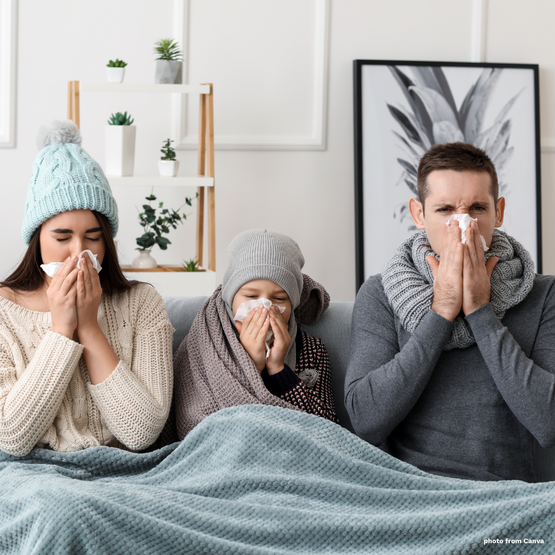
New York State Reports 71,123 Flu Cases This Week
ALBANY, N.Y. (December 26, 2025) - The New York State Department of Health today announced that the state is experiencing the highest number of flu cases ever recorded in a single week.
We are seeing the highest number of flu cases ever recorded in a single week in New York State, State Health Commissioner Dr. James McDonald said. We are closely reviewing hospital bed capacity data to better understand hospitalization trends and to guide any necessary response related to impacts from respiratory viral infections. While influenza activity is elevated, there are simple steps New Yorkers can take to protect themselves and those around them, including getting vaccinated, staying home when sick and practicing everyday preventive measures. Flu is treatable for high-risk people with antiviral medicine, if taken within 48 hours of symptoms.
Earlier this month, the Department declared that influenza is prevalent in New York State. The declaration requires health care facilities and agencies ensure that their personnel who have not received this year's flu vaccine wear masks in areas where patients and residents may be present.
The Department's most recent data shows a total of 71,123 positive flu cases reported for the seven days ending December 20, 2025, the most that the Department has ever recorded in one week since influenza was made reportable in 2004. This is a rise of 38 percent over the previous week. There have been 189,312 positive flu cases reported in New York this season to date.
Hospitalizations due to influenza climbed by 63 percent, up from 2,251 in the previous week to 3,666 across the State.
The number of flu cases reported has risen in recent years with more laboratories testing and reporting results, and with multi-pathogen panels becoming the primary way to test individuals presenting with respiratory symptoms. But this record number underscores that this season is impacting more people than in other recent years. Flu season typically peaks in January.
The latest Respiratory Surveillance Report and Flu Tracker can be found here and here.
It is not too late to get vaccinated against influenza, and the flu vaccine is widely available to those 6 months and older. Young children, pregnant women, people with certain chronic medical conditions and those ages 65 and older are most at risk of developing serious complications from flu.
To treat the flu, there are antiviral medications that can be prescribed by health care providers, such as Tamiflu, which can reduce the length and severity of the illness but must be administered close to the onset of symptoms.
The seasonal influenza vaccine remains the best protection against serious illness and death from the flu. It can help reduce absences from work, school and extracurricular activities, and provides protection for the most vulnerable members of families and communities.
In addition to getting the flu vaccine, simple preventive actions can help stop the spread of influenza and other respiratory viruses:
- Wash hands often with soap and water for at least 20 seconds. If soap and water are not available, use an alcohol-based hand sanitizer.
- Avoid touching eyes, nose and mouth with unwashed hands.
- Avoid close contact with people who are sick.
- Stay home when sick.
- Cover cough or sneeze with a tissue, then throw the tissue in the trash.
- Clean and disinfect frequentlytouched objects and surfaces.
For more information about influenza in New York, visit the Department's flu website.
'Don't Be Salty, New York' Campaign Keeps State Waters Protected
From NYS Department of Environmental Conservation
New York State Department of Environmental Conservation (DEC) Commissioner Amanda Lefton recently joined State and local officials to encourage New Yorkers to reduce the overuse of rock salt when possible, and “Don’t Be Salty, New York.”
Although applying rock salt on roadways, parking lots, and sidewalks helps to ensure the safety of those traveling by vehicle or foot, overuse of salt can be costly for consumers, degrade infrastructure, contaminate runoff that enters streams and waterbodies, and impact drinking water.
“It only takes one teaspoon of salt to pollute five gallons of water,” Commissioner Lefton said. “We’re asking all New Yorkers to take common-sense precautions before using too much rock salt on their sidewalks, driveways, and other places around their homes and businesses to help prevent unknowingly harming our environment. ‘Don’t Be Salty’ and help save your money, remain safe, and protect our waterbodies.”
To help protect water quality while maintaining public safety, DEC launched the “Don’t Be Salty, New York” public awareness campaign to help educate property owners, managers, communities, and snow and ice removal professionals about the impacts of rock salt and the various strategies that can be implemented to reduce salt use. Consistent with a recommendation in the 2023 Adirondack Road Salt Reduction Task Force report, DEC conducted a public survey in 2024 to better understand perceptions surrounding rock salt usage and make appropriate recommendations for reduction strategies to be applied throughout New York.
In August 2025, NYSDOT announced a statewide expansion of its road salt management pilot program for the 2025-26 snow and ice season. NYSDOT takes the issue of road salt management very seriously and for more than a decade has been making efforts to reduce the use of salt while still maintaining a safe and reliable transportation system. These efforts include but are not limited to enhanced training for snowplow operators, direct liquid applications in place of road salt, continuous evaluation of innovative equipment, and utilization of best management practices for reducing road salt. As a result, the statewide average application rate for granular salt was reduced to 172 pounds per lane-mile during the 2024-25 snow and ice season, down from the seven-year statewide average application rate of 194 pounds per-lane-mile.
DEC encourages all New Yorkers to use these “Don’t Be Salty, New York” best practices to save money, reduce rock salt pollution, and stay safe:
Use Rock Salt Sparingly
- Shovel first, if possible, to clear snow and ice before applying rock salt. The less snow and ice there is to melt, the less rock salt is needed;
- Apply rock salt strategically. A 12-ounce cup full of rock salt is enough to treat 250 square feet, a 20-foot single car driveway, or approximately 10 standard sidewalk squares;
- Apply rock salt only where it is needed most, such as walkways, driveways, and steps;
- Use a spreader to evenly distribute salt. Avoid piling it in one area, as this can lead to more salt runoff.
Monitor Weather Conditions
- Rock salt loses effectiveness below 15°F. Sand can be used for traction on ice during a cold snap (and can be swept up in the spring for reusing) or switch to a deicer made for colder temperatures.
- If a snow or ice storm is predicted, consider pre-treating surfaces with rock salt to prevent ice from forming.
Consider Using Alternative Products:
- Consider making your own brine solution at home by combining 3.5 cups of rock salt per gallon of hot tap water and stirring until all salt is dissolved. Let any gravel settle to the bottom. Pour the brine into a regular garden sprayer and spray in a zig-zag pattern over desired area. Save extra brine to use later.
- Use products from the GreenNY specifications listed on the OGS website.
Among the many impacts of rock salt overuse:
- Rock salt can run off into surface waters through snow melt and stormwater or leach into groundwater.
- Excessive rock salt in surface water can cause stress to, or kill, fish and other aquatic organisms.
- Rock salt washed off surfaces will accumulate in soils, which can kill vegetation or deplete plants of nutrients. Eventually, non-native salt-tolerant vegetation could move in and disrupt ecosystems.
- Salty roads attract animals like deer and moose (who love licking up the salt), increasing the probability of accidents and roadkill.
- The presence of sodium in drinking water is problematic for individuals with low-salt or limited-salt dietary restrictions. People on a sodium-restricted diet can experience health risks when exposed to elevated levels of sodium in their drinking water.
- Rock salt has corrosive properties that can corrode metals, including lead, copper, iron, and steel, from pipes and other infrastructure.
- These corrosive effects also impact cars, trucks, bridges, and roads resulting in approximately $5 billion dollars in annual repairs in the U.S. alone (USEPA)
- Households using private wells and small unregulated water systems are at the greatest risk of negative impacts from corrosion. Regulated public water systems sample for lead and copper and reduce corrosion if required.
DEC developed a video depicting the importance of salt reduction and released a podcast episode called Don’t Be Salty New York, available on DEC’s website.
For additional information and resources, visit DEC’s Rock Salt Reduction webpage.

CLICK HERE and become a part of our efforts
to build our new home at Tilly Foster Farm!
Tidbits
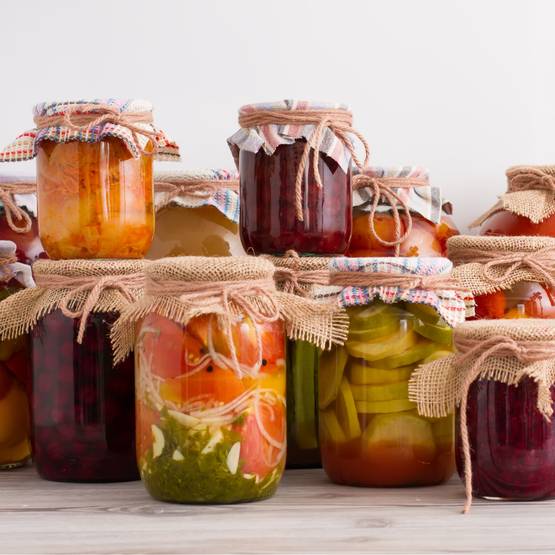
Save the Dates: Food Preservation Lunch and Learn Online Classes
CCE Putnam Ag and Food Systems Coordinator Ruby Koch-Fienberg will be teaching three Thursday Food Preservation Lunch and Learn classes via Zoom.
- Jan. 29 - Winter Ferments
- Feb. 19 - Beginners guide to canning and food preservation
- March 19 - Planning your garden for the jar
Stay tuned for registration information!

4-H Collecting Supplies for Community Health Pantries
4-H volunteers have created and stocked community health pantries in two locations in Putnam County. Our volunteers are seeking items such as travel-size shampoos, toothpaste, alcohol-free mouthwash, lotions, etc. Items can be dropped off at the CCE Putnam office, 1 Geneva Road in Brewster, from 8 a.m. to 4 p.m. Monday through Friday.
At a glance ...

What's Bugging You? First Friday: Stratifying Native Perennial Wildflower Seeds
Friday, Jan. 2,
12 to 12:30 p.m.
Online
Learn how to prepare perennial wildflower seeds to germinate inside. Plus, revisit all of the IPM we learned in 2025 with our annual Year in Review video.
Each month at New York State Integrated Pest Management's "What's Bugging You? First Friday" events, experts share practical information and answer questions on using integrated pest management (IPM) to avoid pest problems and promote a healthy environment where you live, work, learn and play.
See the What's Bugging You? Page for more events.
Register: HERE
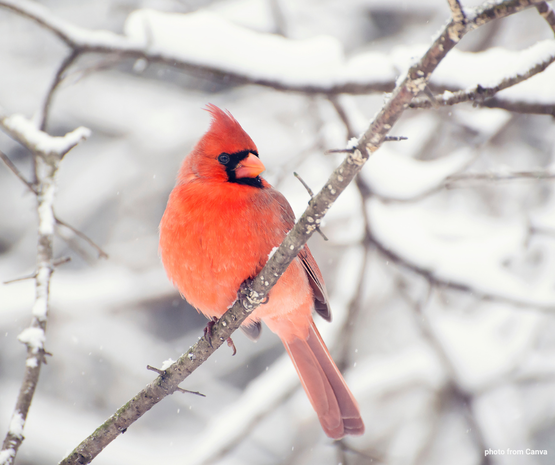
Tilly Tally: Winter Bird Count at the Tilly Foster Farm Forest
Saturday,
Jan. 3
10 a.m. to 3 p.m.
Tilly Foster Farm, 100 Route 312, Brewster
In support of the historic Audubon Christmas Bird Count, join us to take a tally of the birds at Tilly Foster Farm. Help us identify and count the birds sheltering in the forest for the winter, adding to our nature catalog of the "Restore and Regenerate" Forest. This family friendly event will be held in conjunction with Soldiers2Scientists, an organization that engages veterans and their families in citizen science. We'll be joined by Bedford Audubon for hands-on birding fun! This is a "drop-in" event so you can join us for the day or an hour!
Rain/snow date: Jan. 4
Cost: Free
Register: HERE.
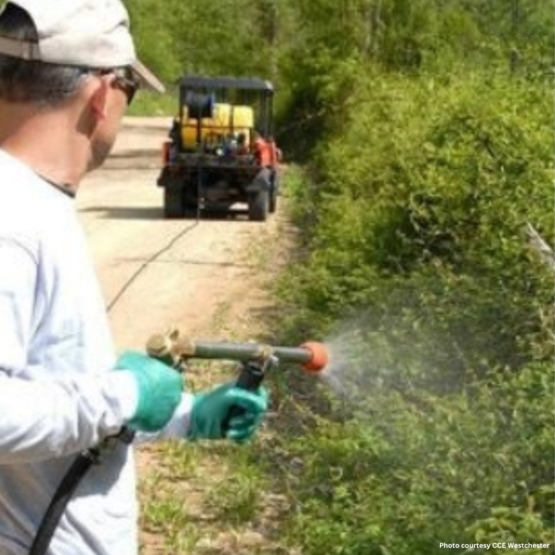
Pesticide Applicator Certification Exam Prep Course
Tuesday, Jan. 13 and Wednesday, Jan. 14
8:30 a.m. to 12:30 p.m.
Online
This course is being offered by CCE Eastern New York Commercial Horticulture Program (ENYCHP).
Prior to attending, participants are encouraged to view the introductory 'How to Obtain a Pesticide Applicator License' webinar on the ENYCHP YouTube page.
Participants should also purchase or borrow the Core Certification Training Manual for Pesticide Applicators and Technicians and appropriate category manual beforehand for category certification sought. Manuals may be purchased from the Cornell Store at this link.
Note that this training IS NOT a substitute for the 30-hour eligibility course. For more information on upcoming 30-hour eligibility courses, search listings on the NYSPAD website here.
Contact Elisabeth Hodgdon with questions and requests for accommodations (eh528@cornell.edu or 518-650-5323). If you require assistance obtaining pesticide training manuals for studying, please reach out to your county extension office, as many have manuals available to borrow.
Cost (per farm): $40
Register: HERE.

2026 New York State Flower Industries Winter Greenhouse & Growers Schools
Wednesday, Jan. 21,
2026
8 a.m. to 3 p.m.
Cornell Cooperative Extension Orange County
18 Seward Ave., Suite 300, Middletown
The event agenda includes : “Building Better Pest Programs – Targeted Timing and Life Cycles”; New York State Flower Industries update; Ag & Markets update; “Avoid Diseases to Have Fabulous Foliage and Flowers”; Efficient technologies, processes, and practices to optimize energy use and related costs in greenhouse operations; and Modern tools and tactics for IPM in greenhouses.
(Morning sessions are available online, so if you can't attend in person, you can still attend via zoom and receive pesticide credits.)
Registration deadline: January 16, 2026
Cost: $60 or $50 for NYSFI members for first member of company. Additional members of same company: $30 or $25 for NYSFI members
Registration includes morning coffee & snacks and lunch
Register: HERE.

CCE Cut Flower Webinar Series
Tuesdays, Jan. 6
through Feb. 3
Online
The fifth annual CCE Cut Flower Webinar Series begins Jan. 6 and continues over 5 weeks on Tuesdays. This is a popular series of online events with speakers, a wide variety of subjects concerning growing cut flowers and plenty of interaction between speakers and attendees. Webinars will be recorded, and all the recordings will be sent to registrants for future review.
NYSDEC pesticide application credits will be provided.
Cost: $60 for all five sessions, $20 for single sessions.
Register HERE.

Livestock and Equine IPM Winter Webinar Series
Jan. 22 through March 5
1-hour Zoom sessions on Thursdays
Join us this winter for a free online webinar series offering livestock and equine producers, extension educators and agricultural professionals the opportunity to learn directly from researchers advancing practical, science-based solutions to on-farm pest challenges. Each session will focus on applying integrated pest management (IPM) principles—combining biological, cultural, mechanical and chemical tactics for effective, environmentally responsible control. Participants will gain tools to identify key pests, understand their life cycles and implement targeted strategies that promote animal health, reduce insecticide use and support beneficial insects.
Cost: Free
Register: HERE.

Tractor Safety 2026 for Youth 14+
Jan. 14 through March 14
This program is open to YOUTH 14+ who need to receive certification to work on a farm this summer and/or who are looking for a fun, educational experience. This program runs from 1/14/2026 to 3/14/2026.
Note: The remote portion of this course will be held through AgSafety4U, a program hosted by Penn State University that allows students to obtain their written certifications independently. Please visit https://ag-safety.extension.org/agsafety4u-certificate-course/ to learn more.
Cost: $30 for 4-H members, $45 for non-members
Register: HERE
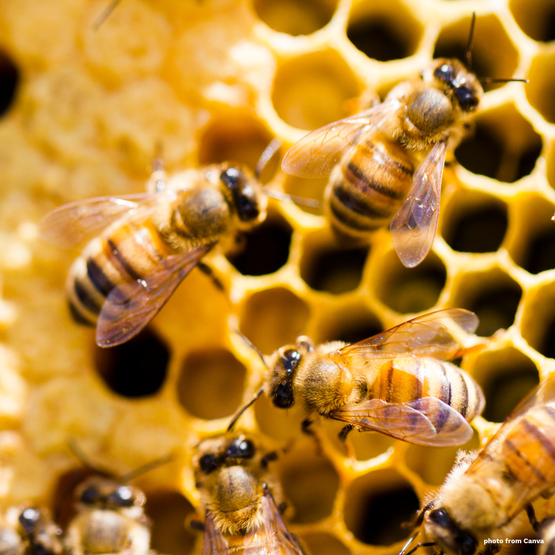
Cornell University Beekeeping Essentials Certificate Program
Want to be a better beekeeper?
Beekeeping plays an important role in preserving pollinator populations and safeguarding biodiversity. Successful beekeepers understand how honey bees function, behave, and thrive. At its core, keeping honey bee colonies healthy and productive hinges on recognition, observation, and knowing how to respond to colony needs to support their success.
In this course, you will explore the fundamentals of honey bee biology and beekeeping, providing you with a comprehensive foundation to become comfortable and confident in managing your own hives. You will begin with the basics of how to get started in beekeeping then explore ways to support your colonies throughout the year. You’ll also discover how to identify and navigate scenarios like swarming, Varroa infestations, and queen issues.
Throughout the course, you will examine ways to apply practical knowledge and hands-on techniques used by experienced beekeepers and Cornell experts to your own colonies. Whether you are brand new to bees or have a few years of experience, this course will enable you to build a strong foundation for successful beekeeping.
This certificate program includes a single course designed for beginner beekeepers who have 0-2 years of beekeeping experience. The course covers the fundamental skills needed to become a successful beekeeper. This instructor-led program allows students to participate in a virtual classroom with fellow beekeepers and the instructor, along with self-paced, asynchronous materials to complete throughout the course duration.
This course fulfills the legal requirements of the State of New Jersey for beekeeper education per New Jersey Administrative Code.
Price: $699
Course Outcomes:
- Recognize the colony members, stages of brood, and food in the hive.
- Explore honey bee biology and behavior.
- Identify your equipment needs.
- Understand how to install your bees.
- Use your hive tool and smoker and work bees gently.
- Inspect a colony.
- Understand colony biology and management throughout the year.
- Interpret brood patterns.
- Determine how to compare your colony observations to seasonal expectations.
- Identify when a colony looks healthy and when it needs additional management.
- Recognize and address queen situations, Varroa mites, diseases and surprises.
- Explore how to manage colonies for honey production, harvest honey and render beeswax.
- Understand how to winter colonies to maximize survival.
Learn more and enroll in Beekeeping Essentials HERE.
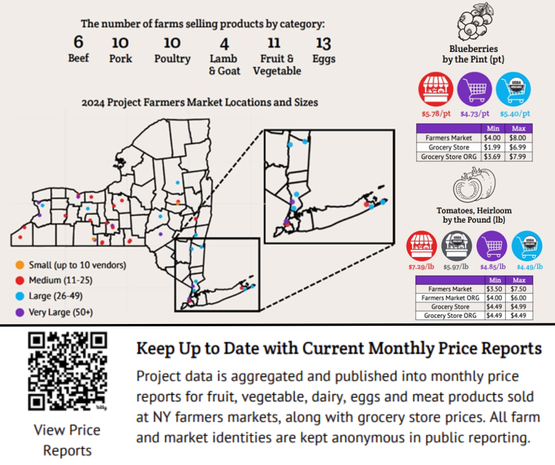
2024 Farm Product Price Reports for Farmers Markets & Grocery Stores in New York
Cornell Agricultural Marketing Research Program recently released a report with the 2024 average prices at farmers markets in NYS. The purpose of the report is to serve as a reference point to aid farmers with price setting. It includes price reports for a selection of meat, egg, vegetable and fruit products from May to December 2024. These price reports group all products into two categories: USDA Certified Organic (ORG) and Not Organic.
The program is looking for additional farms that sell at farmers markets to participate in the price reporting project. Participating farms get free analysis of their data and 1-on-1 consulting to improve performance and increase sales.
They also help to contribute to data availability of market pricing in New York State. Project data is aggregated and published into monthly price reports. All farm and market identities are kept anonymous.
Visit the Farmers Market Research Project to learn more and join!
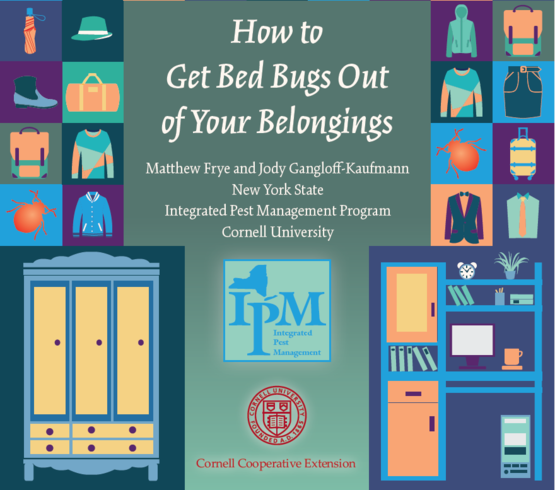
Cornell IPM’s Bed Bug Guide Now Mobile-Friendly
Dealing with bed bugs doesn’t have to mean throwing everything away. Cornell Integrated Pest Management (IPM) has re-released its highly popular guide, “How to Get Bed Bugs Out of Your Belongings,” in a newly updated, accessible, and mobile-friendly format—making it easier than ever to use.
First published in 2018, this trusted resource offers practical, step-by-step solutions for removing bed bugs from everyday items, from shoes and clothing to books and cherished photo albums. Designed for real-life situations, the guide empowers individuals with proven, do-it-yourself techniques that help save belongings and reduce stress.
Ideal for extension professionals, social workers, health departments and home health aides, the guide is a valuable communication and education tool when supporting people facing bed bug infestations.
To access “How to Get Bed Bugs out of Your Belongings” visit: How to Get Bed Bugs Out of Your Belongings – Cornell IPM Help Center . For more information, contact Jody Gangloff-Kaufmann, associate director of community and urban IPM, at jlg23@cornell.edu.

Putnam County's Climate Vulnerability Assessment Survey
Do you live and/or work in Putnam County? Have you experienced flooding, severe winter storms, extreme heat, failing infrastructure, frequent power outages, etc. in your community? Then Putnam County officials want to hear from you!
Visit https://putnamcountyny.gov/ccarp to take the Climate Vulnerability Assessment Survey by Jan. 5.
This survey will be used to inform a county-level Climate Change Adaptation & Resilience Plan (CCARP). Community input will play a key role in the assessment and planning processes.